Modern Dad Pages

Muddy hands and scrammed knees

I put together a blog post earlier this week made up of three of my favourite quotes about play.  I had several comments from people saying how much they like the quotes and how true it is that play is serious business for our children, it’s the way they learn about the world.

One of the comments really stuck with me though.  The writer said that they felt that the traditional, simply play of childhood seems to be disappearing in this modern world.  That our children these days just want to play on electronic devices and aren’t interesting in old-fashioned play any more.

My eldest is only 4, so I don’t have any first hand experience of older children.  It may well be the case that they are more interested in computer games than any other kind of activity.  And certainly my son does like to play on my phone and ipad.  The thing is, I really do think that they have a place in our children’s lives these days.  They’ve been born into a very ‘electronic’ world.  They will need the skills they learn using these devices as they get older.  I also know that Rhys has learnt a lot from watching certain programs on the TV and by playing with various apps on my phone.

But, BUT, he also spends a lot of time engaged in ‘old-fashioned’ play.  The writer of the comment mentioned that we need to try and remind our children how good simply play can be, and I really do agree.  We’ve spent the last two afternoons at the park where Rhys has run around with his friends, learning about co operation, sharing and taking turns, using his imagination playing house in the bushes, testing his body by climbing and jumping.  And I’ve been very conscious of finding a balance between hovering and making sure he’s safe, and standing back and letting him get on with it.

See, there’s been a lot of talk recently about our children’s safety.  This video of a man leading children away from a playground recently popped up on my Facebook newsfeed.  It seemed to prove that our children aren’t safe out in public; that even if we’ve taught them not to talk to strangers they are still likely to go off with them given half a chance.  And if you just quickly watch the video you’ll most likely be terrified and want to keep your children by your side where you can keep them safe.  It’s scare stories like this that are all over the media that are causing parents to be so reluctant to let their children run around outside.  It’s much safer to just keep them in and let them play on the ipad!

Which is why I’m so glad I found this article on freerangekids.com, which argues against most of the points made in the video.  I highly recommend you go and read it.  It might help put your mind at rest a little bit.

There are always dangers to our children.  Lenore Skenazy from free range kids makes the great point that we could drive our children to school to keep them safe from predators, only to be hit by a truck instead.  The point being, we can’t guarantee our children’s safety 100% of the time.  There will always be freak accidents.  There will always be illness.  And yes, unfortunately, there will always be sick people out there with bad intentions towards our children.

But that is life.  We can’t hide ourselves and our children away.  There is so much more good in the world than bad.  I for one want my children to be bold and to explore all the wonderful things out there.

So I’m working on finding a balance.  My children will play on electronic devices; they can learn a lot from them and have fun.  But they will also draw and paint and make things with play doh.  They’ll explore our slightly out of control garden.  They’ll go to the park and test their boundaries and play in the bushes.  They’re still so young that I try my damn best to keep them in sight at all times, because in all honesty it does scare me what might happen if they’re out of sight.

But I don’t want to hover.  I don’t want their main memory to be me telling them to ‘be careful’.  I want them to remember me telling them to have fun instead!  That’s what childhood is about. muddy hands and scrammed knees and just having fun!

What are your thoughts on this?  Have you seen the video?!  How willing are you to let your kids out to play like we probably did when we were little?

Modern Dad Pages

To ad to

Picture

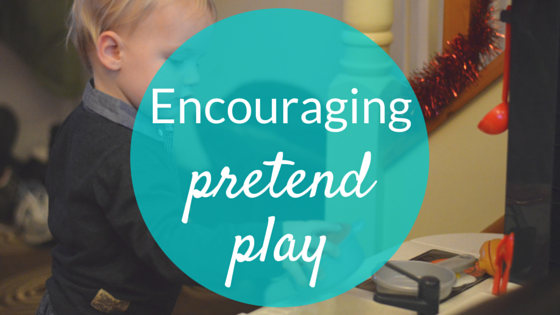
Encouraging pretend play

“For children play is serious learning.  Play is really the work of childhood” – Fred Rogers

It’s now well established that play is incredibly important to children and their development.  In fact, it’s so important that it’s been recognised as a human right for every child by the United Nations High Commission for Human Rights.

I love watching my children play.

Waiting to see what toys they’ll make a beeline for at playgroup.  Seeing the different ways they decide to play with them.

Recently I’ve noticed Rhys getting much more creative in his play.  He’s had a play kitchen for a few years and has always liked ‘cooking’ with it, but his pretend play has definitely changed in the last few months.  He’ll play with a few soft toys now, coming up with scenarios for them and making all the different toys ‘talk’.

It’s fascinating to watch and I love seeing that creative, imaginative side of him!

Which makes me think about what I can do to encourage him to continue this pretend play and to introduce it to Nerys.

Picture

After doing some research I’ve come up with these three suggestions for how I can encourage my children to engage in pretend play, and the benefits of it for them:

Provide props, suggest several uses and encourage open-ended play
 

One of the big things we can do to encourage our children to engage in pretend play is to provide them with the necessary props.  This can be as elaborate as buying or making them a whole play kitchen, complete with toy food and pots and pans, or it can be as simple as gathering their soft toys and some sheets of paper so they can play ‘schools’!The main point here is to provide props so that the play is open ended.  Let the child make the decisions about how exactly they’ll use the items provided and what scenarios they want to act out.  Psychological studies have found that this type of play promotes creative problem solving skills.  One study in particular, by Wyver and Spence (1999) suggested that there is a causal connection between pretend play and a child’s ability to solve divergent problems (these are problems that have several possible outcomes, as opposed to a convergent problem which only has one correct answer).

Wyver and Spence (1999) found that children who were encouraged to participate in pretend play, and who were shown how to do so, then showed an increased ability to solve divergent problems.  Interestingly, they also found that children who were trained in solving divergent problems then showed increased rates of pretend play!

So perhaps if you have a child who really isn’t interested in pretend play you can encourage them to look at divergent problems with you and discuss possible solutions; this may in turn lead them to naturally show more of an interest in pretend play.  You might have an empty box, that another child would naturally grab and turn into a racing car.  

If your child doesn’t seem interested in using the box for pretend play you could try and spark their creativity by discussing with them all the different ways you could use the box and encourage them to come up with as many suggestions of their own as they can!


Introduce a play mate

At the moment Rhys seems to particularly like engaging in pretend play by himself.  I’m very conscious of the fact that I need to encourage him to play co operatively with other children.  I really need to set up some after-school play dates!

Playing with other children can be hugely beneficial.  Watching another child engaged in pretend play can give your child ideas of how to play himself.  By observing they can learn how a certain toy or prop could be used.

Engaging in pretend play with other children is also important for a child’s social skills and has the added benefit of increasing their ability to self-regulate (their impulses, emotions and attention).  A study by Lillard et al (2013) found that children who frequently engage in pretend play with other children have stronger self-regulation skills.  

Which does seem to be logical; after all, if you’re pretend playing with another child you both have to agree about what pretend things you’re doing and how you’re playing!  

The children have to learn to conform to a set of rules and the researchers suggest that practising conforming to rules like this could help children to develop better self-control and self-regulation over time.

Talk about the things you do as an adult and encourage them to copy you.

A lot of children will naturally want to copy what their parents are doing, grabbing a brush to help you clean up or making dinner in their play kitchen.

If you’re child doesn’t instinctively do these things you can encourage them by talking about the things you’re doing and then offering them tools to play alongside you.  So if you’re cooking dinner you could give your child a few bowls and spoons and dry pasta to mix up and transfer from bowl to bowl.

This kind of ‘real-life’ play has been found to help prepare children for actual real life challenges.  A study by Lancy in 2008 found that children all round the world engage in play activities that mimic the kinds of things they’ll be doing as adults.  The study also found that when older children or adults engage in the play with them and use that opportunity to teach them about the activities the children do take that information in, showing that children really do learn through play!

Do you think these tips are helpful?  Does your child naturally seem to enjoy pretend play?  I’d love to hear about the kinds of pretend play they enjoy!  

Mummascribbles
Picture

The importance of ‘please’ and ‘thank you’

Over the last week or two Nerys has started to sign ‘please’ and ‘thank you’.  This makes me stupidly happy.  Like, a bit more happy than I feel it really should?!

A big part of this happiness comes from the simple pleasure of watching her grow and learn and start to really communicate with us.  But another huge part of it is that it really is important to me that my children are polite and say ‘please’ and ‘thank you’.

Picture 

I’ve written a few posts recently about focusing on the good things in our lives and how feeling and expressing gratitude is good for our mental and physical health.  I do want my kids to be grateful for things partly for that reason, I think they’ll be happier people if they appreciate everything they have and things other people do for them.

Interestingly though, a study carried out in 2010 by Grant and Gino (published in the Journal of Personality and Social Psychology) found that saying thank you also has a positive effect on the person being thanked.  When we say ‘thank you’ to people it can strengthen our relationship with them, let them know that we value what they’ve done for us and, apparently, can also make them more likely to help us again in the future.

In the study a group of participants were asked to give feedback on a cover letter for a job application for a made-up student.  When the student then asked for more feedback a day or two later, 66% of the participants agreed when he wrote a ‘thankful’ email, compared to just 32% of participants who agreed when he wrote the request in a ‘neutral’ tone.  That’s quite a dramatic increase; seeming to prove that we are in fact much more likely to help people again in the future if they express their gratitude for the things we do for them.

The researchers looked into this further and found that the reason we’re more likely to help those who thank us again is that the ‘thank you’ makes us feel that our help was appreciated, that we’re needed and that it makes us feel more socially valued.  It seems that hearing the words ‘thank you’ helps us feel reassured that our help is valued, which in turn motivates us to provide more help in the future.

So, teaching Rhys and Nerys to say ‘thank you’ will have positive effects on them and those that they’re interacting with!

Besides, it’s just the right thing to do isn’t it?!  If someone does something for you, or gives you something, it’s just polite to acknowledge it with a thank you.  And it does seem to brighten the postman’s day when he hands Rhys our post and gets a very enthusiastic ‘thank you’ back!

Do you agree?  Do you think it’s important to teach your children to say ‘please’ and ‘thank you’ at an early age?  I’d love to know what other people think!

Mummascribbles
Picture

To my son as he turns 4

To my strong-willed, handsome, bright and busy boy,

You turned 4 last week, which I still can’t quite believe.  You have changed and grown up so much in the last year; really leaving that little toddler behind and turning into a real little boy.

Here’s what you’ve been up to and what you enjoy these days:

  • You have settled in amazingly well at nursery school, happily running in every morning to see your new friends.
  • You still love numbers as much as you always have done, and can now count up to 100 and can tell me the which numbers are odd and even up to about 20.
  • You’re enjoying learning how to write all your letters properly, with the flicks and everything ready for joined up writing.
  • You absolutely love playing angry birds.
  • You’ve possibly watched a few too many videos on youtube of other people playing games, seeing as now when you play the games you like to narrate what you’re doing  – “Oh hi guys, today we’re playing angry birds go…”
  • After a few stressful trips to the hairdressers with Nana and Pops you’ve now realised that actually it’s not so bad and have been for 2 very successful haircuts with me this year.
  • You would quite happily eat sandwiches for every meal if we let you.
  • You love to watch ‘let’s play’ on Cbeebies and ‘Doc McStuffins’ on Disney junior.
  • You like to draw maps and tell us all about them and how they show us that we need to go from our house to the park.
  • You are a great big brother.  When Nerys was inconsolable with teething pain, you got out of bed to offer her your favourite bed time toy.  When she refused to take it you went and put it in her cot for her to cuddle later.  You have no idea how touched me and Daddy were by your kindness.
Rhys, you really are growing into a fab little boy.  You are sensitive and bright and you make us very proud.  There may be some days when I’m just exhausted by bedtime with all your questions and general busy-ness, but I really wouldn’t change you for the world!  You bring so much joy to me and Daddy and we love you so, so much.

Happy Birthday!

Love Mummy.
xxx