
“For children play is serious learning. Play is really the work of childhood” – Fred Rogers
It’s now well established that play is incredibly important to children and their development. In fact, it’s so important that it’s been recognised as a human right for every child by the United Nations High Commission for Human Rights.
I love watching my children play.
Waiting to see what toys they’ll make a beeline for at playgroup. Seeing the different ways they decide to play with them.
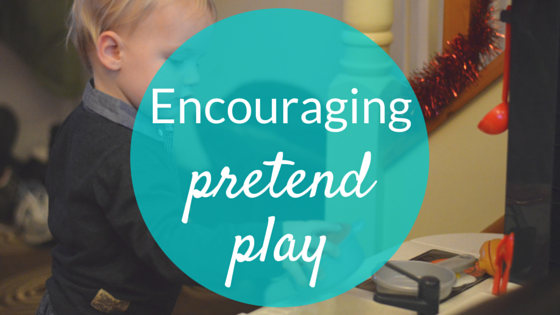
Recently I’ve noticed Rhys getting much more creative in his play. He’s had a play kitchen for a few years and has always liked ‘cooking’ with it, but his pretend play has definitely changed in the last few months. He’ll play with a few soft toys now, coming up with scenarios for them and making all the different toys ‘talk’.
It’s fascinating to watch and I love seeing that creative, imaginative side of him!
Which makes me think about what I can do to encourage him to continue this pretend play and to introduce it to Nerys.
Provide props, suggest several uses and encourage open-ended play
One of the big things we can do to encourage our children to engage in pretend play is to provide them with the necessary props. This can be as elaborate as buying or making them a whole play kitchen, complete with toy food and pots and pans, or it can be as simple as gathering their soft toys and some sheets of paper so they can play ‘schools’!The main point here is to provide props so that the play is open ended. Let the child make the decisions about how exactly they’ll use the items provided and what scenarios they want to act out. Psychological studies have found that this type of play promotes creative problem solving skills. One study in particular, by Wyver and Spence (1999) suggested that there is a causal connection between pretend play and a child’s ability to solve divergent problems (these are problems that have several possible outcomes, as opposed to a convergent problem which only has one correct answer).
Wyver and Spence (1999) found that children who were encouraged to participate in pretend play, and who were shown how to do so, then showed an increased ability to solve divergent problems. Interestingly, they also found that children who were trained in solving divergent problems then showed increased rates of pretend play!
So perhaps if you have a child who really isn’t interested in pretend play you can encourage them to look at divergent problems with you and discuss possible solutions; this may in turn lead them to naturally show more of an interest in pretend play. You might have an empty box, that another child would naturally grab and turn into a racing car.
If your child doesn’t seem interested in using the box for pretend play you could try and spark their creativity by discussing with them all the different ways you could use the box and encourage them to come up with as many suggestions of their own as they can!
Introduce a play mate
At the moment Rhys seems to particularly like engaging in pretend play by himself. I’m very conscious of the fact that I need to encourage him to play co operatively with other children. I really need to set up some after-school play dates!
Playing with other children can be hugely beneficial. Watching another child engaged in pretend play can give your child ideas of how to play himself. By observing they can learn how a certain toy or prop could be used.
Engaging in pretend play with other children is also important for a child’s social skills and has the added benefit of increasing their ability to self-regulate (their impulses, emotions and attention). A study by Lillard et al (2013) found that children who frequently engage in pretend play with other children have stronger self-regulation skills.
Which does seem to be logical; after all, if you’re pretend playing with another child you both have to agree about what pretend things you’re doing and how you’re playing!
The children have to learn to conform to a set of rules and the researchers suggest that practising conforming to rules like this could help children to develop better self-control and self-regulation over time.
Talk about the things you do as an adult and encourage them to copy you.
A lot of children will naturally want to copy what their parents are doing, grabbing a brush to help you clean up or making dinner in their play kitchen.
If you’re child doesn’t instinctively do these things you can encourage them by talking about the things you’re doing and then offering them tools to play alongside you. So if you’re cooking dinner you could give your child a few bowls and spoons and dry pasta to mix up and transfer from bowl to bowl.
This kind of ‘real-life’ play has been found to help prepare children for actual real life challenges. A study by Lancy in 2008 found that children all round the world engage in play activities that mimic the kinds of things they’ll be doing as adults. The study also found that when older children or adults engage in the play with them and use that opportunity to teach them about the activities the children do take that information in, showing that children really do learn through play!
Do you think these tips are helpful? Does your child naturally seem to enjoy pretend play? I’d love to hear about the kinds of pretend play they enjoy!

Really interesting blog post! Informative and great detail x
Thank you! Glad you enjoyed it! x
Very informative. I love this post as I do like to encourage my toddler to play a lot and have noticed how much she’s learned from playing. She is starting to pretend play now too! She loves holding anything up to her ear and pretend to talk to it like it’s a phone! 🙂 #twinklytuesday
That’s so sweet, my daughter has just started doing the same thing! I love the random things they use as phones too! x
This is great advice for parents and other caregivers. There are so many electronic toys these days that do all the “work” for the child – by talking, making sounds, etc. It’s good to remind ourselves that kids don’t need these – and that they can have a ton of fun creating their own scenarios and worlds from imagination.
I also encourage my kids to enjoy pretend play by reading with them and enacting parts of the books through dress up, puppets and more! I posted about it here: http://wp.me/p4fhx0-3l .
Great to find you through #TwinklyTuesday!
Oh wow, just read your post, you’ve put me to shame! I’m very inspired now to get so much more out of the books I read with my children, thank you for sharing that link! x
Any more thoughts about sending these to a parenting magazine?
This is great advice! I also recommend participating in his pretend play yourself. My girls are 9 and still like me to join in their imaginary worlds with them. I really think that my knowledge of all their pretend characters helps keep us close. Thanks for linking up with #TwinklyTuesday.
That’s a great thought Sadia, I could do with participating more with them as they get more into their imaginary worlds! x