
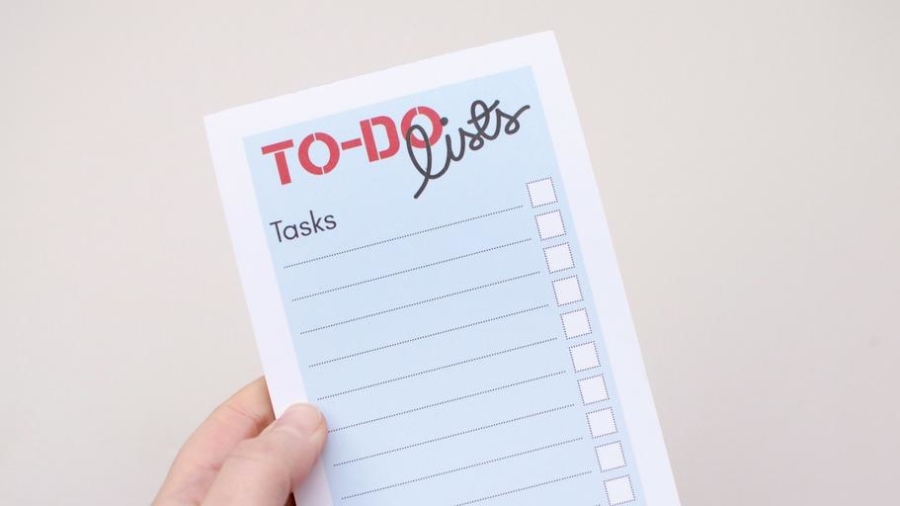
If you’re anything like me, you’ll know that feeling of having a thousand and one things that you’re trying to keep track of, and keep on top of every day. I find it utterly exhausting trying to keep up with my mental to-do list. I much prefer getting everything out of my head and on to paper.
I still feel though that I’m not getting the best out of my to-do lists.
One reason for this is that I tend to have several lists on the go at once, so I still feel completely overwhelmed and end up losing track of where I’ve even put some of those lists.
So if you, like me, need some help to rock your to-do list and actually get stuff done, this is the post for you.

I think most of us love a good to-do list.
One of the reasons they help us feel better is down to a psychological phenomenon called the Zeigarnik effect that comes into play when we get all our to-dos out of our heads and onto paper.
Zeigarkik, a Russian psychologist, was watching waiters in a busy restaurant one day and noticed that they were brilliant at remembering what people had ordered. But as soon as the dishes were served, the memory of who had ordered what just vanished. It wasn’t important any more for them to remember the order. They had completed that task and so there was no need for their brains to hang on to that bit of information any more.
What Zeigarnik concluded from watching all this, was that we tend to remember the things we need to do better than things we have completed.
A more recent study by Baumeister and Masicampo at Wake Forest University took this idea a little further. They found that our brains are occupied with the things we need to get done, but simply writing down a plan for getting them done can free up that brain space and stop us feeling so anxious and overwhelmed by how much we have to do.
So that’s a bit of the psychology behind why to-do lists are so useful, and now we can get to the part about rocking yours and getting more stuff done!
Get it all out.
The best place to start is with a huge brain dump.
Grab a pen and a notebook and get everything single task that is floating around your head down on paper. Don’t try and edit yourself at this stage, just write down every last to-do that you can think of.
Break it down.
Go through your list and start to break it down. I like to split my to-dos into separate lists for my blog, my photography and my life in general.
From there start looking at any tasks that are really big and overwhelming, or just a big vague.
Make sure each item on your to-do list is easily actionable. So rather than have something like ‘get fit’ on your list, you want to have a few things like ‘book an induction at the gym’ and ‘buy new running shoes’.
Get your priorities straight.
Look through your list and work out which tasks are the most important/urgent. Then look at the tasks that will bring you the most results. The Pareto Principle states that, in many cases, 80% of the effects come from 20% of the causes.
If you take a look at all the items on your list, it most likely that only a few of them are related to important issues. These are the tasks you want to prioritise and try and clear off your list first according to the Pareto Principle. Those few important tasks will produce the most significant results, more so than if you clear off 20 smaller, less important tasks from your list.
Make a plan and set a deadline.
Once you know which tasks to focus on first, set yourself deadlines for when those tasks need to be completed. Be realistic with your deadlines, but be strict with yourself too. Parkinson’s law states that work expands to fill the time available for its completion.
So if you have a task that needs to be done by the end of the day, you will get it finished before you head to bed. But if you decide that actually it needs to be done by the end of the week, then it will take that long to complete it.
Giving yourself a tight deadline forces you to fight against the urge to procrastinate and just get things done.
Celebrate your completed tasks.
I’m not saying you should throw yourself a party or crack open the champagne, but giving yourself a little reward for crossing items off your to-do list isn’t a bad idea. It’s all down to operant conditioning. If you celebrate completing one of your tasks with a little reward, then you’ll feel good about it, and so be more likely to want to keep going and cross more things off your list.
Speaking of which, make sure you actually cross things off your list. Psychologically, this gives you a sense of achievement, a little boost which encourages you to keep working on the rest of the list.
Hopefully this approach to tackling your to-do list will help make it more efficient and you more productive.
The main thing really though, is to just start taking action on it. Just do something, anything, to get some momentum going and get some items crossed off that list.
Look for little windows of time when you can fit in some of the smaller jobs on your list, like phoning to make your dentist appointment while waiting for the kettle to boil for your mid morning cuppa. Having a well-organised to-do list means that when you find yourself with a bit of time, you can get straight on with tackling the important tasks, rather than trying to work out what needs to be done.
Are you a to-do list fan? Do you work better with a paper copy of your list, or have you moved to a digital system? I would love to know what works best for you!